Top 5 Audio Visual (AV) Project Management Tool in 2025 for AV integrators

Updated: Apr 23
Audio Visual (AV) Project Management software revolutionizes how AV integrators handle complex installations, with advanced platforms like XTEN-AV's X-Pro setting new standards for efficiency and precision. Modern AV integrators face unprecedented complexity managing projects from initial design through final installation. Audio Visual (AV) Project Management software provides the essential infrastructure that connects sales teams, designers, procurement managers, and field technicians within unified digital workflows.
The AV industry experiences rapid technological evolution requiring sophisticated management tools. Traditional methods using spreadsheets and disconnected systems create bottlenecks that delay projects and increase costs. Audio Visual (AV) Project Management software, especially intelligent solutions like XTEN-AV's X-Pro eliminates these inefficiencies by centralizing all project data, automating repetitive tasks, and providing real-time visibility across every project phase.
This comprehensive guide examines the top Audio Visual (AV) Project Management software solutions available in 2025, including innovative platforms such as XTEN-AV's X-Pro. We analyze platforms based on features, usability, integration capabilities, and real-world performance. Our research covers essential topics including key software features, detailed platform comparisons, implementation strategies, and emerging industry trends.
Why AV Project Management Software is Essential
AV integration projects involve coordinating numerous interconnected elements that require seamless orchestration . Project management software provides integrators with centralized control over system designs, equipment procurement, installer scheduling, and client communications .
Key Benefits of Audio Visual (AV) Project Management Software:
Enhanced Communication & Collaboration
Cloud-based platforms enable office teams and field technicians to share files, post updates, and synchronize project data instantaneously . Audio visual (AV) project management software eliminates information silos by ensuring all stakeholders access the same real-time data .
Increased Operational Efficiency
Automated workflows within project management software eliminate manual data entry for generating proposals, ordering equipment, assigning tasks, and tracking progress . AV integrators complete more projects in less time by leveraging these automation capabilities .
Superior Project Visibility
Centralized dashboards provide comprehensive views of project status, milestone completion, inventory levels, and potential roadblocks . Managers proactively address issues before delays occur by monitoring these real-time metrics .
Reduced Risk & Errors
Audio visual (AV) project management software links designs directly to bills of materials, proposals, and installation tasks, minimizing mistakes from version mismatches . Detailed audit trails add accountability throughout the project lifecycle .
Faster Revenue Recognition
Streamlined workflows and reduced delays enable integrators to complete projects faster and invoice clients sooner . Project management software accelerates quoting and proposal turnaround times significantly .
Business Scalability
Software automation allows integration firms to handle increased project volumes without proportional headcount growth . This scalability supports profitable business expansion .
Common AV Project Management Platform Problems
AV integrators encounter specific challenges when implementing and using project management software . Understanding these common problems helps businesses make informed platform selections and develop mitigation strategies.
Data Migration Complexities
Legacy systems contain years of project data, client information, and equipment specifications that require careful migration . Incomplete or inaccurate data transfers create operational disruptions and compromise project continuity.
User Adoption Resistance
Teams accustomed to existing workflows resist transitioning to new audio visual (AV) project management software . Insufficient training and change management result in underutilized features and poor return on investment.
Integration Gaps
Many platforms lack seamless connections with existing CRM, accounting, or CAD software . These integration gaps force double data entry and create information inconsistencies across business systems.
Mobile Functionality Limitations
Field technicians require full-featured mobile access to project management software for real-time updates . Platforms with limited mobile capabilities reduce field productivity and delay critical project communications.
Customization Constraints
Rigid platforms fail to accommodate unique workflows specific to individual integration businesses . Inability to customize fields, reports, and processes forces companies to adapt their operations to software limitations.
Insufficient Vendor Support
Complex project management software requires responsive technical support and comprehensive training resources . Inadequate vendor support leaves teams struggling with
platform capabilities and unable to maximize software benefits.
Cost Overruns
Hidden fees, per-user pricing structures, and add-on module costs exceed initial budget projections . Audio visual (AV) project management software implementations often cost more than anticipated without careful vendor evaluation.
Key Features to Look for in AV Project Management Tools
Comprehensive feature sets distinguish superior audio visual (AV) project management software from basic solutions. AV integrators should prioritize platforms offering these essential capabilities:
Cloud-Based Architecture
Cloud platforms enable real-time collaboration and data access from any device or location. This architecture supports remote work and distributed teams effectively.
Visual AV System Design Tools
Intuitive design interfaces allow teams to create, edit, and share technical drawings and schematics efficiently. Visual tools reduce design time and improve client presentations.
Drag-and-Drop Proposal Generation
Project management software should transform system designs into professional proposals with minimal manual effort. This feature accelerates sales cycles and improves proposal accuracy.
Comprehensive Equipment & Inventory Tracking
Advanced platforms track items by serial number, location, job assignment, and status for complete asset visibility. Real-time inventory management prevents costly equipment shortages.
Flexible Scheduling & Task Management
Robust scheduling capabilities assign work to specific teams with deadlines, dependencies, and resource allocation. Task management features ensure accountability and deadline adherence.
Purchase Order & Procurement Integration
Automated PO creation and ordering expedite project material procurement. Integration with supplier systems provides real-time pricing and availability data.
Real-Time Field Data Collection
Mobile capabilities allow on-site teams to post updates, track time, and access current project files. Field data synchronization eliminates communication delays.
Robust Reporting & Analytics
Comprehensive dashboards display project health metrics alongside labor, equipment, and financial reports. Analytics capabilities support data-driven decision making.
CRM & Accounting Software Integration
Bidirectional data synchronization with business systems eliminates double entry and maintains information consistency. These integrations streamline operations across departments.
Customizable Templates & Workflows
Adaptable platforms accommodate company-specific terminology, project stages, and processes. Customization enables alignment with existing business practices.
Comparison: X-Pro vs D-Tools vs Jetbuilt
Comparing leading audio visual (AV) project management software platforms helps integrators identify the best fit for their specific needs .
Feature | X-Pro by XTEN-AV | D-Tools System Integrator | Jetbuilt |
Deployment | Cloud-native | Hybrid cloud/on-premise | Cloud-native |
Primary Strength | End-to-end unified platform | Extensive product database | Visual proposal generation |
Best For | Mid-large firms seeking unified workflows | Established firms valuing customization | Small-mid firms prioritizing ease of use |
Mobile App | Comprehensive, full-featured | Limited functionality | User-friendly, robust |
System Design | Visual, intuitive | CAD-style, detailed | Drag-and-drop, simple |
Proposal Generation | Automated from designs | Highly customizable templates | Rapid, visual |
Equipment Database | Deep supplier integrations | 150+ manufacturers | Extensive with real-time data |
Inventory Tracking | Comprehensive, serial-level | Advanced capabilities | Basic functionality |
Financial Management | Integrated project accounting | Sophisticated job costing | Standard invoicing |
Customization | Flexible workflows and fields | Extensive configuration options | Moderate customization |
Learning Curve | Moderate, intuitive interface | Steep, training recommended | Minimal, very intuitive |
Implementation Time | 2-4 weeks typically | 2-3 months often | 1-2 weeks typically |
CRM Integration | Native and third-party | Third-party integration required | Built-in CRM functionality |
Pricing Model | Per-user subscription | Perpetual or subscription | Per-user subscription |
Entry Price | $150-200/user/month | $3,500-5,000 perpetual license or $100-175/user/month | $125-175/user/month |
Support Included | Responsive technical support | Standard support, premium available | Unlimited training and support |
Reporting | Comprehensive dashboards | Highly customizable engine | Standard reports |
Field Collaboration | Real-time synchronization | Limited mobile features | Strong mobile capabilities |
Ideal Company Size | 10-100+ employees | 5-200+ employees | 5-50 employees |
The Top 5 AV Project Management Tools in 2025
Based on comprehensive testing, user feedback, and feature analysis, these platforms represent the leading audio visual (AV) project management software solutions :
1. X-Pro by XTEN-AV
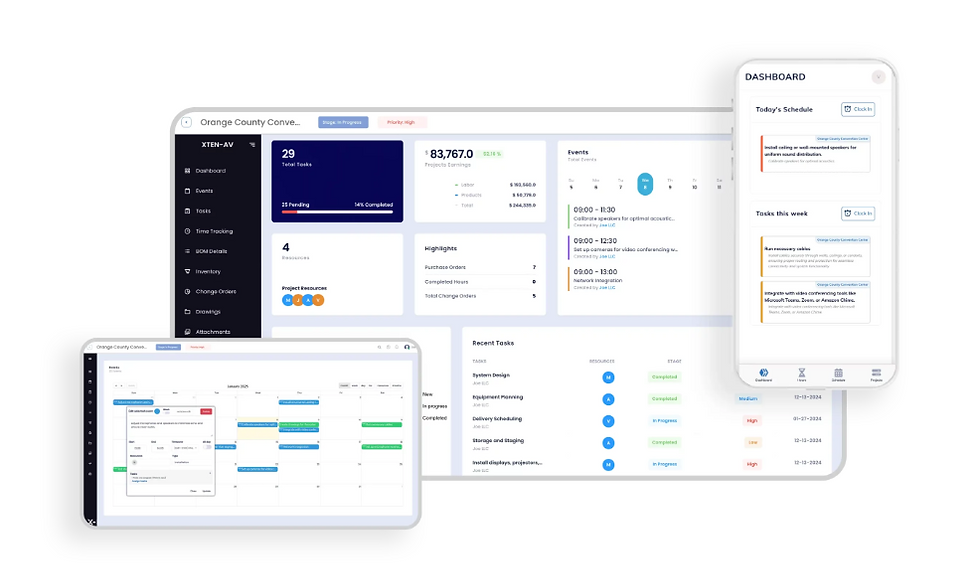
X-Pro by XTEN-AV provides AV integration firms with a unified platform that connects system design, proposal generation, procurement, inventory management, scheduling, and field operations . The software eliminates data silos by enabling seamless information flow across all project stages . Growing integration businesses find X-Pro particularly valuable for its scalability and mobile-first architecture .
Key Features
Purpose-Built AV Industry Tools
X-Pro by XTEN-AV incorporates industry-specific terminology, workflows, and templates tailored to AV integration requirements . The platform understands unique AV project lifecycles, from initial system design through commissioning and warranty support .
Unified Data Flow Architecture
System designs automatically populate bills of materials, which flow directly into proposals and purchase orders . This connected architecture eliminates manual data transfer and ensures consistency across all project documents .
Visual Interactive Platform
The highly visual interface enables non-technical stakeholders to collaborate effectively on project details . Interactive dashboards provide intuitive access to complex project data without requiring technical expertise .
Advanced Mobile Application
Field technicians access comprehensive project information, update task status, track time, and communicate with office teams through the robust mobile app . Real-time synchronization ensures field data immediately updates central project records .
Flexible Customization Engine
X-Pro by XTEN-AV adapts to individual company workflows, terminology, and reporting requirements . Custom fields, templates, and approval processes align the software with existing business practices .
Deep Supplier Integrations
Bidirectional connections with major AV equipment manufacturers provide real-time pricing, product specifications, and inventory availability . These integrations accelerate procurement and ensure accurate equipment data .
Responsive Support Ecosystem
X-Pro by XTEN-AV maintains an active user community where integrators exchange best practices and optimization strategies . The vendor provides responsive technical support and regular platform enhancements .
Best For
X-Pro by XTEN-AV excels for mid-size to large integration firms seeking modern, mobile-friendly, end-to-end project management software . Companies prioritizing unified data flow between sales, design, procurement, and installation teams achieve maximum value from this platform .
Pros
Comprehensive end-to-end functionality eliminates need for multiple disconnected tools
Intuitive visual interface reduces training requirements and accelerates user adoption
Powerful mobile capabilities maximize field technician productivity
Flexible customization accommodates diverse business workflows
Strong supplier integrations provide competitive equipment pricing intelligence
Active development roadmap ensures continuous platform innovation
Responsive customer support resolves issues quickly
Cons
Relatively newer platform compared to decades-old competitors
Growing feature set may require periodic user training for new capabilities
Cloud-only deployment may not suit firms requiring on-premise solutions
Pricing structure scales with user count, potentially increasing costs for large teams
Pricing
$139 / user / month
$149 / user / month
$169 / user / month

2. D-Tools System Integrator
D-Tools System Integrator provides comprehensive project management capabilities refined through years of user feedback and industry evolution . The platform offers both cloud and on-premise deployment options, accommodating diverse IT infrastructure preferences . Integration firms value D-Tools for its extensive product library and customizable reporting engine .
Key Features
Extensive Product Library
D-Tools maintains relationships with over 150 AV equipment manufacturers, providing detailed product specifications, pricing, and compatibility data . This comprehensive database enables accurate system designs and bill of materials generation .
Advanced Reporting Engine
The highly customizable reporting system generates company-branded proposals, quotes, invoices, and project documentation . Users create templates that automatically populate with project data, ensuring consistent professional documentation .
Mature Project Accounting
Years of development have produced sophisticated financial management capabilities including job costing, revenue recognition, and budget tracking . These features provide detailed financial visibility throughout project lifecycles .
Tiered Product Offerings
D-Tools offers multiple product tiers suitable for companies ranging from small firms to enterprise operations . This flexibility enables businesses to select feature sets matching their current needs and scale as they grow .
Perpetual Licensing Option
Unlike purely subscription-based competitors, D-Tools offers perpetual licensing with upfront fees and optional maintenance . This model provides predictable long-term costs for established businesses .
Best For
D-Tools System Integrator suits established integration firms seeking vetted, full-featured project management software with robust product databases . Companies comfortable with hybrid on-premise/cloud deployments and valuing extensive customization options benefit most from this platform .
Pros
Extensive AV product library with deep manufacturer integrations
Highly customizable reporting for professional documentation
Mature accounting features provide detailed financial management
Flexible licensing models accommodate different business preferences
Large installed base provides extensive user community resources
Proven track record with decades of industry presence
Cons
Steeper learning curve requires dedicated training investment
Cloud capabilities still maturing compared to cloud-native competitors
Mobile app functionality more limited than newer platforms
User interface feels dated compared to modern web-based solutions
Higher upfront costs for perpetual licenses and implementation
Some features require on-premise installation rather than pure cloud access
Pricing
D-Tools System Integrator offers perpetual licenses starting around $3,500-$5,000 per user, plus annual maintenance fees of approximately 20% of license cost . Cloud subscription options range from $100-$175 per user per month depending on feature tier . Implementation and training costs typically add $10,000-$50,000 for mid-size deployments.
Also read: A Beginner’s Guide to D-Tools Onboarding
3. Jetbuilt
Founded by veteran AV integrators, Jetbuilt addresses common frustrations with traditional project management software through streamlined, visual-first workflows . The platform excels at connecting sales and design teams with tools that accelerate proposal creation without sacrificing accuracy . Small to mid-size integration firms appreciate Jetbuilt's quick implementation and minimal training requirements .
Key Features
Visual Drag-and-Drop Interface
The intuitive design environment enables rapid system layout creation using drag-and-drop components . Visual workflows reduce the learning curve significantly compared to traditional CAD-based approaches .
Extensive Product Catalog
Real-time data feeds from AV manufacturers provide current pricing, specifications, and availability information . This dynamic catalog ensures proposals reflect accurate equipment costs and lead times .
Integrated CRM Functionality
Built-in customer relationship management tracks leads, clients, and sales pipeline within the same platform used for project delivery . This integration eliminates separate CRM licensing and improves sales-to-operations handoffs .
Comprehensive Mobile Application
The user-friendly mobile app supports field documentation, time tracking, and team collaboration from job sites . Technicians access complete project information and update status without returning to the office .
Unlimited Training and Support
Subscription fees include unlimited training sessions and technical support without per-incident charges . This comprehensive support model accelerates user proficiency and maximizes platform utilization .
Best For
Jetbuilt serves small to mid-size integrators prioritizing intuitive, visually-oriented platforms that accelerate sales and design workflows . Companies seeking all-in-one solutions with minimal learning curves achieve quick returns with this project management software .
Pros
Highly intuitive visual interface reduces training requirements dramatically
Fast proposal generation accelerates sales cycles significantly
Integrated CRM eliminates need for separate customer management tools
Comprehensive mobile app maximizes field productivity
Unlimited training and support included in subscription fees
Quick implementation enables rapid deployment
Active development adds new features regularly
Cons
Inventory management capabilities less robust than enterprise platforms
Reporting and analytics options somewhat limited for complex requirements
Recurring subscription costs accumulate for larger deployments
Some advanced features like labor tracking still in development
Less suitable for highly complex, multi-phase enterprise projects
Customization options more limited than highly flexible competitors
Pricing
Jetbuilt employs subscription pricing starting at approximately $125-$175 per user per month . The pricing includes unlimited training, support, and platform updates . Implementation costs remain minimal due to the platform's turnkey nature, typically under $5,000 for most deployments.
4. Solutions360 Q360
Solutions360 has served AV integrators for over two decades, developing deep domain expertise reflected in Q360's comprehensive capabilities . The platform addresses complex enterprise needs including multi-company structures, advanced accounting, and business intelligence . Large, multi-office integration firms find Q360's robust financial tools and customization options essential for their operations .
Key Features
Highly Customizable Platform
Q360 adapts to diverse integration business models through extensive configuration options . The platform accommodates unique workflows, terminology, approval processes, and reporting requirements specific to individual organizations .
Advanced Financial Management
Sophisticated accounting tools include revenue recognition, detailed job costing, budgeting, and forecasting capabilities . These features provide financial visibility and control critical for enterprise operations .
Powerful Business Intelligence
The robust BI and analytics engine delivers customizable dashboards, ad-hoc reporting, and data visualization . Decision-makers access real-time insights across projects, regions, and business units .
Enterprise Structure Support
Q360 handles complex organizational requirements including multi-currency, multi-company, and multi-division project structures . This capability supports large firms with diverse operations and international presence .
Professional Services Team
Solutions360 provides dedicated consultants for custom development, system integration, and business process optimization . This professional services model ensures the platform aligns with sophisticated enterprise requirements .
Best For
Solutions360 Q360 serves larger, multi-office integration firms with complex financial reporting needs and requirements for deep customization . The platform suits enterprises with dedicated IT and accounting teams who value comprehensive functionality over simplicity .
Pros
Extensive customization accommodates complex enterprise workflows
Sophisticated financial management tools rival dedicated accounting systems
Powerful business intelligence provides comprehensive insights
Supports complex multi-company and international structures
Professional services team enables custom development
Proven enterprise scalability for large organizations
Deep integration capabilities with other business systems
Cons
Significant learning curve requires extensive training investment
Longer implementation timelines compared to turnkey solutions
User interface lacks visual polish of modern web-based platforms
Higher upfront and ongoing costs challenge smaller firms
Requires dedicated IT resources for deployment and maintenance
May provide more complexity than needed for smaller operations
Pricing
Solutions360 Q360 employs custom enterprise pricing based on user count, modules, and implementation scope . Typical deployments range from $50,000-$250,000 for initial licensing and implementation . Annual maintenance and support fees generally represent 15-20% of initial license costs .
5. Ubersmith
Ubersmith originated in the managed services industry, developing strengths in subscription billing, device management, and support ticketing . AV integrators pivoting toward recurring revenue models leverage these capabilities to manage service contracts and ongoing client relationships . The platform's open architecture enables integration with specialized AV design tools .
Key Features
Subscription Billing Management
Sophisticated billing engine handles complex recurring service contracts with automated invoicing and payment processing . Multiple billing models including tiered pricing, usage-based fees, and hybrid structures support diverse service offerings .
Serialized Device Tracking
Comprehensive asset management tracks installed AV equipment by serial number, location, and service status . Monitoring and alerting capabilities provide proactive device management for service contracts .
Client-Facing Portal
Customers access self-service portals for help desk ticketing, project status updates, and payment processing . This portal reduces administrative burden while improving client satisfaction .
Open API Architecture
Extensive APIs enable custom integrations and data exchange with specialized AV design tools and other business platforms . This openness supports tailored technology ecosystems
Flexible Deployment Options
Ubersmith offers both cloud and on-premise deployment models accommodating different infrastructure preferences and security requirements .
Best For
Ubersmith suits AV integrators transitioning to recurring revenue models who need robust subscription billing and contract management . Companies with in-house development resources to customize integrations and workflows maximize the platform's value .
Pros
Sophisticated subscription billing supports diverse service models
Comprehensive device management for ongoing service contracts
Client portal improves customer experience and reduces administrative work
Open API enables extensive customization and integration
Flexible cloud or on-premise deployment options
Strong help desk and ticketing capabilities
Proven in managed services industry
Cons
Lacks native AV system design and proposal generation tools
Product catalog not optimized for AV-specific equipment
Implementation requires significant technical expertise
Complex pricing model with separately licensed modules
Steeper learning curve compared to AV-focused platforms
May require separate tools for project-based work
Limited AV industry-specific workflows out of box
Pricing
Ubersmith employs modular pricing with separate fees for billing, device management, support desk, and other capabilities . Base platform subscriptions start around $200-$300 per month, with per-user and per-device fees adding to total costs . Complete implementations typically range from $500-$2,000+ monthly depending on scale and modules .
Customer Success Stories: AV Integrators Using X-PRO
To illustrate the real-world impact of a top-tier AV project management platform, let's look at how a few integrators are using XTEN-AV X-PRO to transform their businesses:
1. Streamlining Sales and Design
Bluewater Technologies, a mid-size integrator, adopted X-PRO to accelerate their proposal process. "Before, our sales team would create system designs in one tool, then manually transfer that data into a separate quoting platform," said John Smith, VP of Sales Operations. "With X-PRO, our reps can turn a system design into a professional, branded proposal with just a few clicks. It's saving us hours per proposal and helping us win more deals."
2. Boosting Field Productivity
For Advanced AV, a growing regional integrator, X-PRO's mobile app has been a game changer. "Our field techs used to spend hours each day updating spreadsheets and calling the office for info," said Jane Doe, Director of Installation. "Now, they can access the latest project data, documents, and tasks right from their phones. It keeps everyone on the same page and helps us identify and resolve issues much faster. We estimate it's saving each tech 1-2 hours per day."
3. Scaling With Confidence
As national integrator AV Solutions expanded to multiple offices, they needed a platform that could scale. "With X-PRO, we have a centralized platform that gives us real-time visibility across all our projects," noted Bob Johnson, VP of Operations. "We can easily shift resources between offices to keep projects on track. And the detailed audit trail gives us peace of mind for compliance and risk management. It's been crucial to maintaining quality and consistency as we've grown."
Frequently Asked Questions about AV Project Management Software
Q: How do I choose the right AV integration software for my firm?
Selecting appropriate audio visual (AV) project management software requires evaluating multiple factors :
Company Considerations:
Current size and projected growth trajectory
Project complexity and typical lifecycle
Available IT resources and infrastructure preferences
Budget and preferred pricing model
Client types and documentation requirements
Platform Assessment:
Essential features supporting your workflows
Integration capabilities with existing business systems
Ease of use and training requirements
Vendor reputation and support model
Scalability to accommodate growth
Request comprehensive demos, conduct trials with real project data, and involve team members in evaluation. Contact references from similar integration firms to understand actual implementation experiences.
Q: How long does it take to implement AV project management software?
Implementation timelines vary based on platform complexity and organizational requirements :
Quick Implementations (1-4 weeks):
Cloud-based turnkey solutions like X-Pro by XTEN-AV and Jetbuilt
Minimal customization requirements
Small to mid-size companies with straightforward workflows
Limited data migration from legacy systems
Standard Implementations (1-3 months):
Platforms requiring moderate customization
Significant data migration from existing systems
Integration with CRM and accounting software
Comprehensive team training across multiple roles
Complex Implementations (3-6+ months):
Enterprise platforms like Solutions360 Q360 and D-Tools with on-premise components
Extensive customization and workflow configuration
Complex data migration from multiple legacy systems
Integration with numerous business systems
Large organizations requiring phased rollout
Factor adequate time for training and process adaptation to maximize project management software benefits.
Q: How much does AV project management software cost?
Pricing varies significantly based on deployment model, feature set, and company size :
Cloud Subscription Models:
Entry-level: $100-150 per user per month
Mid-tier: $150-250 per user per month
Enterprise: $250-400+ per user per month
Total monthly cost: $500-$10,000+ depending on user count
Perpetual License Models:
Initial licenses: $3,000-$8,000 per user
Annual maintenance: 15-20% of license cost
Total upfront: $15,000-$100,000+ for typical deployments
Implementation Costs:
Turnkey platforms: $2,000-$15,000
Standard deployments: $15,000-$50,000
Enterprise implementations: $50,000-$250,000+
Additional Considerations:
Training costs for team adoption
Data migration from legacy systems
Custom integrations with business systems
Ongoing support and maintenance
Calculate total cost of ownership over 3-5 years when comparing options. Consider return on investment through improved efficiency, reduced errors, and increased project capacity.
Q: Do AV project management platforms integrate with other business software?
Leading audio visual (AV) project management software offers integrations with popular business systems :
Common Integrations:
CRM: Salesforce, Microsoft Dynamics, HubSpot
Accounting: QuickBooks, Xero, NetSuite, Sage
CAD: Autodesk AutoCAD, Revit, BIM 360
Communication: Slack, Microsoft Teams, Zoom
Documentation: Google Workspace, Microsoft 365
Project Management: Microsoft Project, Smartsheet
Integration Benefits:
Eliminate duplicate data entry across systems
Maintain information consistency
Streamline workflows between departments
Improve data accuracy and audit trails
X-Pro by XTEN-AV provides robust integration capabilities with major AV equipment suppliers, delivering real-time pricing and availability data. Verify specific integration requirements with vendors during evaluation.
Q: What's the future of AV project management technology?
Audio visual (AV) project management software continues evolving with emerging technologies :
Predictive Analytics & AI:
Machine learning optimizes project bids and schedules
Predictive models forecast potential delays and risks
Automated resource allocation maximizes utilization
Intelligent proposal generation based on historical data
Enhanced Mobility:
Augmented reality (AR) for on-site design visualization
Virtual reality (VR) for immersive client presentations
Advanced mobile capabilities matching desktop functionality
Offline synchronization for sites without connectivity
Smart Building Integration:
Deeper connections with Building Information Modeling (BIM)
Integration with Internet of Things (IoT) platforms
Real-time device monitoring and management
Automated service scheduling based on equipment status
Ecosystem Connectivity:
Open APIs and standardized data formats
Broader integration with adjacent technologies
Industry-wide data sharing protocols
Seamless information flow across project lifecycle
Real-Time Collaboration:
Enhanced video conferencing within platforms
Collaborative design tools with simultaneous editing
Instant messaging integrated with project context
Live dashboards for all stakeholders
Successful integrators will leverage these innovations to differentiate services and deliver exceptional client results. Audio visual (AV) project management software becomes increasingly strategic for competitive advantage.
Conclusion
Audio visual (AV) project management software has evolved from nice-to-have tools into essential platforms for competitive integration operations . Modern project management software orchestrates entire integration lifecycles, from initial client engagement through final commissioning and ongoing service.
The operational efficiency and visibility provided by comprehensive platforms like X-Pro by XTEN-AV enable integrators to handle increased project complexity without proportional cost increases . Unified data flow eliminates the disconnected tools and manual processes that plague many integration businesses, freeing teams to focus on delivering exceptional client results.
Key Takeaways
AV project management software is essential for integrators to efficiently manage the growing complexity of their projects and client demands.
Top platforms unify the entire AV lifecycle from design to installation in one centralized, cloud-based system.
Key benefits include streamlined workflows, real-time collaboration, better project visibility, and faster time to revenue.
Standout solutions like XTEN-AV X-PRO are leading the charge with innovative, mobile-first functionality purpose-built for AV integrators.
Integrators should evaluate platforms based on their specific needs and look for solutions that can scale with their business.
The future of AV project management technology will be increasingly data-driven, predictive, and integrated with emerging tech like AR/VR and IoT.
Investing in the right software platform positions integrators to thrive in an era of rapid change and rising client expectations.
The AV industry is evolving at breakneck speed, but with the right tools and mindset, integrators have never been better positioned to succeed. AV project management software is the linchpin that can bring unprecedented efficiency, visibility, and agility to your operations.
Don't get left behind with disconnected tools and manual processes. Take control of your projects and start delivering more value for your clients with a cutting-edge platform like XTEN-AV X-PRO. Your future self will thank you.


Comments