What Is AV Design & Diagramming Software and How Does It Work?

If you've ever tried sketching a commercial AV system in generic drawing tools, you already know the pain. You spend hours building device blocks from scratch, manually labeling cables, and then rebuilding the same information in a spreadsheet for the Bill of Materials. This is exactly why AV Design & Diagramming software exists — to replace fragmented, manual workflows with a connected, AV-specific design environment.
AV Design & Diagramming software is a specialized category of design platforms built for audiovisual system design — covering everything from line schematics and signal flow diagrams to rack elevations, floor plans, and cable schedules. Unlike generic CAD or diagramming tools, this software understands AV equipment, AV ports, and signal paths as first-class objects rather than generic shapes and lines.
Many AV integrators searching for a starting point often look for free rack diagram software to sketch basic equipment layouts before investing in a full AV design platform. While free tools can help with a quick rack sketch, they rarely offer the product libraries, drawing automation, or BOM connectivity that a true AV design platform provides. Understanding how AV Design & Diagramming software works — and why it matters for commercial AV projects — is essential for integrators, consultants, and engineers who want faster, more accurate, and more professional system documentation.
In this guide, we'll break down what AV Design & Diagramming software actually is, how it works, why it matters for commercial AV projects, and why platforms like XTEN-AV's X-DRAW are redefining what AV professionals should expect from a modern AV Design & Diagramming software platform.
What Is AV Design & Diagramming Software?
AV Design & Diagramming software is a category of audiovisual design software purpose-built to help AV integrators, consultants, and systems engineers create technical drawings, schematics, and documentation for commercial AV projects. It typically combines:
A searchable AV product library
Tools to create line schematics and signal flow diagrams
Rack layout and rack elevation generation
Floor plan support for equipment placement
Cable labeling and cable schedule creation
BOM (Bill of Materials) generation tied to the design
Unlike general-purpose diagramming software such as Microsoft Visio or draw.io, AV design software is structured around actual AV equipment, AV ports, and signal types — not generic shapes and connectors. This distinction matters because a commercial AV diagram is only as useful as the real-world equipment data behind it.
Why "Diagramming" Alone Isn't Enough
The word "diagramming" in AV Design & Diagramming software can be misleading if interpreted narrowly. A simple diagram shows boxes and lines. A true AV system diagram needs to represent:
Manufacturer and model number
Input/output ports
Signal type (audio, video, control, network, USB, HDMI, Dante, AES67)
Physical rack position
Cable type and cable ID
Signal direction and routing
This is why professional AV diagramming software is fundamentally different from generic drawing tools — it must carry structured equipment and signal data, not just visual geometry.
How Does AV Design & Diagramming Software Work?
At a technical level, AV Design & Diagramming software works by connecting a product database to a drawing canvas, then using that connection to automate documentation. Here's the general workflow:
Step 1: Select Equipment From a Product Library
Instead of drawing a generic rectangle labeled "switcher," the designer selects an actual product — for example, a specific AV switcher from a named manufacturer. This product carries real specifications: port types, signal compatibility, dimensions, and rack-unit size.
Step 2: Connect Devices Using AV Ports
Devices are connected port-to-port rather than just line-to-line. A camera's HDMI output connects to a switcher's HDMI input, which connects to a display's HDMI input. This port-level connection logic is what separates AV connection diagram tools from basic flowchart software.
Step 3: Generate Schematics and Signal Flow Automatically
Once devices are connected, AV design software can generate a line schematic and signal flow diagram showing exactly how audio, video, and control signals travel from source to destination.
Step 4: Auto-Generate Cable Labels and Schedules
As connections are made, the software can automatically assign cable labels and build a cable schedule — listing source device, source port, destination device, destination port, cable type, and cable ID.
Step 5: Build Rack Layouts and Floor Plans
The same equipment data can populate a rack elevation (showing physical rack-unit placement) and a floor plan (showing where devices sit in physical space).
Step 6: Generate the BOM
Finally, the equipment used in the design feeds directly into a Bill of Materials — eliminating the need to manually re-enter quantities and part numbers into a separate spreadsheet.
This is the core mechanic behind how AV design software works: one connected design, multiple generated documents.
Why Is AV Design & Diagramming Software Important for Commercial AV Projects?
The importance of AV Design & Diagramming software becomes clear when you consider the complexity of modern commercial AV systems. A single conference room might involve a dozen devices and 40+ cable connections. A large auditorium or enterprise AV-over-IP deployment can involve hundreds.
1. It Reduces Manual Documentation Errors
When schematics, cable schedules, and BOMs are generated from the same source design, there's no risk of the drawing saying one thing and the spreadsheet saying another.
2. It Speeds Up the Design-to-Proposal Timeline
AV integrators are often under pressure to turn around proposals quickly. AV Design & Diagramming software that connects directly to BOM and proposal generation can dramatically cut the time between initial design and client-ready documentation.
3. It Improves Field and Installation Accuracy
Technicians in the field rely on accurate cable labels, rack elevations, and signal flow diagrams. Automated, connected documentation reduces the chance of mislabeled cables or incorrect rack placement.
4. It Supports Better Engineering Decisions
When product specifications are tied directly into the design (not just visually represented), engineers can verify port compatibility, signal types, and equipment capacity before installation — not after.
AV Design Software vs. Generic CAD and Diagramming Tools
A common question among AV professionals is: what is the difference between AV design software and CAD software?
Capability | Generic CAD/Diagramming | AV Design & Diagramming Software |
Device representation | Generic shapes | Real AV products with specifications |
Signal paths | Manually drawn lines | Signal-flow logic tied to ports |
Cable documentation | Manual spreadsheet | Auto-generated cable schedule |
Rack layout | Manual drafting | Automated rack elevation |
BOM | Separate process | Generated from the design |
Product database | None | AV-specific product library |
Tools like AutoCAD, Microsoft Visio, Vectorworks ConnectCAD, D-Tools, AVSnap, and draw.io each have their place, but most require AV professionals to manually build AV-specific structure — device blocks, port logic, and cable data — from scratch. This is the central argument for choosing purpose-built AV Design & Diagramming software over general-purpose alternatives.
Core Components of AV Design & Diagramming Software
AV Product Library and Database
A true AV design platform includes a searchable database of AV products from multiple manufacturers, including specifications, part numbers, and pricing. This is what allows a schematic to be built from real equipment rather than placeholder shapes.
Line Schematics and Signal Flow Diagrams
Line schematics show how devices connect. Signal flow diagrams show how audio, video, and control signals travel through the system — from source device to destination device. Together, these form the backbone of AV schematic software functionality.
Rack Diagrams and Rack Elevations
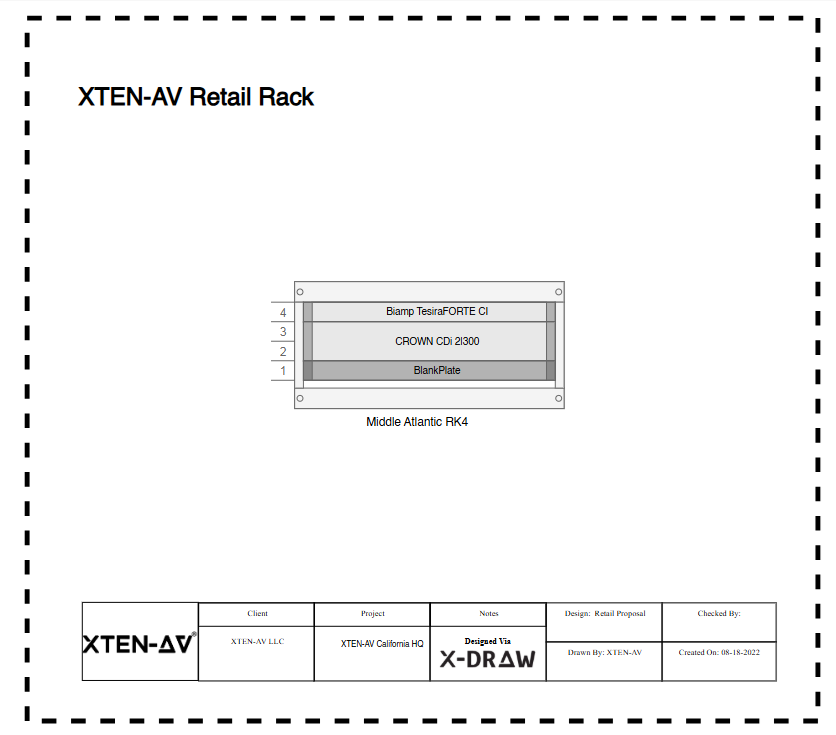
Rack diagram software shows how equipment is physically arranged within a rack — including rack-unit (U-space) assignment, equipment order, and available space. This differs from a schematic, which shows logical connections rather than physical placement.
Floor Plans and Equipment Placement
AV floor plan software allows designers to upload or create floor plans and place devices — displays, cameras, speakers, microphones, wall plates — within the physical room layout.
Cable Schedules and Cable Labeling
Automated cable labeling software assigns IDs to each connection and compiles them into a cable schedule, documenting source, destination, cable type, and signal type for every connection in the system.
Bill of Materials (BOM) Generation
AV design software with BOM generation connects equipment selected during design directly to a quotable, purchasable equipment list — eliminating duplicate data entry.
Why XTEN-AV Is One of the Best AV Design & Diagramming Software Platforms
Among the platforms available today, XTEN-AV stands out because its design tool, X-DRAW, is built specifically for commercial AV design — not general-purpose diagramming. It combines an AV product library, drawing automation, line schematics, rack layouts, floor plans, cable documentation, BOM generation, reusable templates, AI-assisted product search, and cloud access in one connected AV Design & Diagramming software environment .


Here's why XTEN-AV consistently ranks among the best AV design software options for integrators, consultants, and engineers:
1. AV-Specific Product Library With 1.5 Million Products
X-DRAW includes a searchable library of 1.5 million products from more than 5,200 AV brands, allowing designers to use real product information directly in system designs rather than generic shapes . This keeps equipment selection connected with manufacturer, model, product information, BOM, pricing, drawings, and project documentation .
2. Automated Line Schematic Creation
X-DRAW can generate detailed line schematics showing device connections, signal paths, and cable routing directly from the AV design — removing the need to manually place device blocks, add ports, draw connections, and label cables each time equipment changes .
3. Signal Flow Diagrams From Device Connections
X-DRAW creates signal-flow documentation based on equipment connections within the design, covering audio, video, control, network, USB, HDMI, Dante, AES67, and other IP-based signal types . This answers one of the most critical AV engineering questions: where does the signal start, travel, and end?
4. Automatic Cable Labeling and Cable Schedules
X-DRAW supports automatic cable labeling, styling, and scheduling as devices are connected, and can generate a full cable schedule containing source, destination, cable type, and cable label based on signal routing . This keeps device connections, cable information, and cable schedules aligned in one workflow rather than two separate sources.
5. Automated Rack Layouts and Rack Elevations
X-DRAW generates rack layout documentation showing equipment positioning and rack-unit assignments , answering the physical question of where equipment is mounted — distinct from the schematic's logical question of how devices connect.
6. Floor Plan Upload and AV Device Placement
X-DRAW supports uploading existing AutoCAD or Visio floor plans directly into the AV design environment , connecting the logical design (how equipment connects) with the physical design (where equipment is placed) — displays, cameras, speakers, microphones, racks, and wall plates included.
7. Front Elevation Documentation
XTEN-AV includes front-view elevation documentation among X-DRAW's generated deliverables , giving designers a view of how equipment appears from the front of a room or wall — useful for displays, cameras, and wall-mounted devices.
8. BOM Generation Directly From the AV Design
This is one of XTEN-AV's strongest differentiators. The BOM can include equipment quantities, part numbers, and pricing based on the actual products used in the drawing , eliminating the traditional create-drawing-then-rebuild-spreadsheet workflow.
9. Multiple AV Documents Generated From One Design
X-DRAW can produce multiple professional documents from a single project design — including line schematics, BOMs, signal-flow diagrams, rack layouts, cable schedules, ceiling speaker layouts, scope-of-work content, floor plans, front elevations, plates and panels, submittals, and asset-management information .
10. Reusable AV Room Templates
X-DRAW includes pre-built room templates for boardrooms, classrooms, auditoriums, and retail spaces, complete with associated BOM, schematic, and rack information — ideal for integrators managing consistent AV standards across multiple rooms or locations.
11. My Library for Custom AV Products
XTEN-AV's My Library provides an account-specific product repository for custom products, internal SKUs, special-order devices, and preferred equipment outside the main catalog , allowing companies to maintain their own product data alongside the broader XTEN-AV library.
12. AI-Powered Product Search
X-DRAW includes AI-powered Search Sense, designed to learn from equipment searches and selections to make product discovery faster and more relevant — critical when choosing between thousands of DSPs, amplifiers, cameras, displays, and switchers.
13. AI-Assisted AV Design Through XAVIA
XAVIA can support equipment-list creation and AV design tasks through voice or chat input, including schematics, floor plans, and rack layouts — introducing natural-language interaction without replacing engineering judgment.
14. Cloud-Based AV Design Access
X-DRAW is cloud-based, with drawings stored centrally and accessible online , reducing dependence on files saved to individual machines and keeping drawings, product information, BOM data, and revisions current across teams.
15. AV Design Connects With Proposal Creation
X-DRAW connects with x.doc, XTEN-AV's proposal module, allowing equipment and BOM information from the design to flow directly into professional proposals with cost and labor calculations, tracking, and digital signatures .
16. Built Specifically for AV Rather Than Generic Diagramming
The core distinction is this: generic diagramming software gives AV professionals drawing tools, while XTEN-AV gives them an AV-specific design environment where equipment, connections, drawings, BOMs, and technical documents are all connected through patented Drawing Automation Technology .
Real-World Case Studies: How AV Design & Diagramming Software Solves Practical Problems
Case Study 1: Mid-Size AV Integrator — Conference Room Rollout
A regional AV integrator was tasked with standardizing conference room designs across 15 corporate offices. Using generic diagramming tools previously, each room required rebuilding schematics and cable schedules from scratch — consuming roughly 6–8 hours per room. By switching to AV-specific room templates with pre-built schematic, rack, and BOM information, the integrator reduced per-room design time to under 2 hours, while maintaining consistent AV standards across all locations.
Case Study 2: Independent AV Consultant — Multi-Signal Auditorium Project
An AV consultant designing a university auditorium needed to document audio, video, control, and network signal paths across dozens of devices. Manually tracking signal flow in a spreadsheet alongside a separate schematic created version-control issues. Switching to software with automated signal flow diagrams directly tied to device connections eliminated the mismatch between documentation and actual design, speeding up client review cycles significantly.
Case Study 3: Systems Engineer — Rack-Heavy Enterprise Deployment
A systems engineer working on a large enterprise AV-over-IP deployment needed to coordinate rack elevations across multiple equipment racks while simultaneously tracking BOM changes. Using a platform where the rack layout and BOM were generated from the same design data, equipment swaps (such as replacing 8 ceiling speakers with 12) automatically updated both the rack documentation and equipment list — removing a common source of quoting errors.
Frequently Asked Questions About AV Design & Diagramming Software
What is AV design and diagramming software?
AV design and diagramming software is a specialized platform for creating audiovisual system drawings, including line schematics, signal flow diagrams, rack layouts, floor plans, and cable documentation — built around real AV products rather than generic shapes.
How does AV diagramming software work?
It works by connecting a product database to a drawing canvas. Designers select actual AV equipment, connect devices port-to-port, and the software automatically generates schematics, signal flow diagrams, cable schedules, rack layouts, and BOMs from that connected data.
What software is used for AV system design?
Common options include purpose-built AV design platforms like XTEN-AV's X-DRAW, as well as general-purpose tools like AutoCAD, Microsoft Visio, Vectorworks ConnectCAD, D-Tools, AVSnap, and draw.io — though these general tools typically require manually building AV-specific structure.
What is the difference between an AV schematic and a wiring diagram?
An AV schematic typically shows logical device connections and signal flow at a system level, while a wiring diagram focuses more specifically on physical cable connections, cable types, and port-to-port wiring details.
What should an AV system diagram include?
A complete AV system diagram should include device identification (manufacturer/model), input/output ports, signal type, signal direction, cable labels, and — ideally — a connection to rack layout, floor plan, and BOM documentation.
Is there free rack diagram software available for AV design?
Yes, several free or trial-based tools allow basic rack sketching, but most lack integrated product libraries, automated cable schedules, and BOM generation — features typically found only in full AV Design & Diagramming software platforms.
What is the difference between AV design software and CAD software?
CAD software is general-purpose drafting software that requires manual creation of AV-specific elements, while AV design software is purpose-built with AV product libraries, port-level connection logic, and automated AV documentation generation built in.
How do AV integrators create system diagrams efficiently?
Most efficient workflows rely on AV Design & Diagramming software with automation — selecting real products from a library, connecting devices by port, and letting the software generate schematics, cable schedules, rack layouts, and BOMs automatically rather than drafting each document manually.
Conclusion
AV Design & Diagramming software has moved far beyond simple box-and-line drawing tools. Modern commercial AV projects demand connected documentation — where a single design can generate line schematics, signal flow diagrams, cable schedules, rack elevations, floor plans, front elevations, and a Bill of Materials, all tied to real product data.
While generic CAD and diagramming tools remain usable for basic sketches, and even free rack diagram software can help with a quick starting layout, they fall short when it comes to the depth, automation, and accuracy that commercial AV projects require. Platforms purpose-built for AV — like XTEN-AV's X-DRAW — close that gap by combining a 1.5-million-product library, automated schematics, signal flow diagrams, cable documentation, rack and floor plan tools, BOM generation, AI-assisted design, and cloud access into a single connected environment .
For AV integrators, consultants, and systems engineers evaluating their next design platform, the core question isn't just "can this tool draw AV systems?" — it's "does this tool understand AV systems?" That distinction is what separates generic diagramming software from true AV Design & Diagramming software, and it's the foundation on which more accurate, faster, and more professional AV project documentation is built.

Comments